How Market Odds & Resolution Work
By Vir Sanghavi, Founder, Ravioli · Updated May 23, 2026
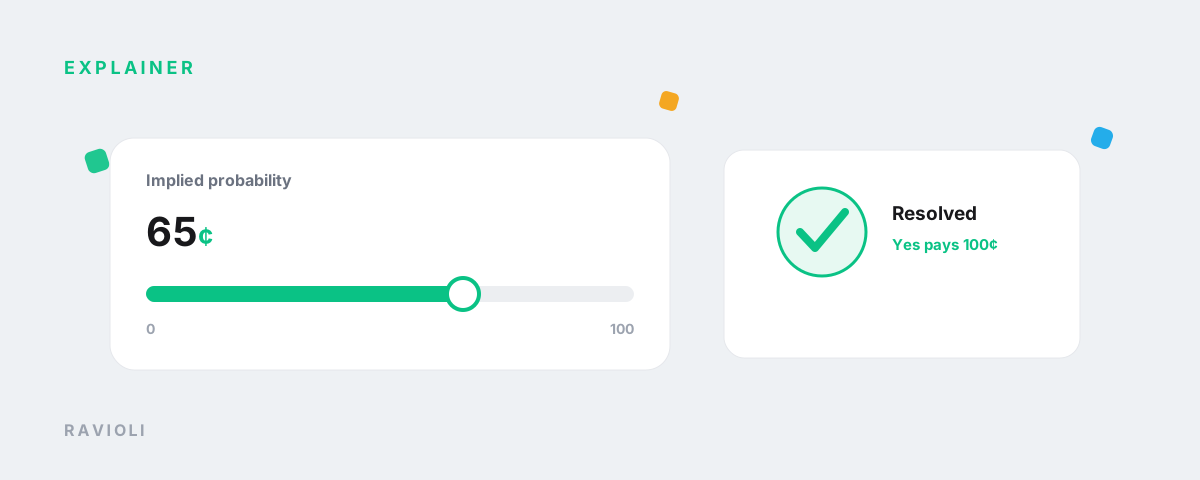
The first time you look at a prediction market, the numbers can feel cryptic. Why is one side 72 and the other 28? What makes those move? And what actually happens at the end? This article answers all three, covering odds, pricing, and resolution, in plain terms.
What do the odds and prices actually mean?
On Ravioli, prices are quoted in cents, from 0 to 100. A share that costs 72 cents is the market's way of saying the event has roughly a 72% implied probability of happening.
The trick that makes this work: a winning share is worth exactly 100 cents. So the price is the probability, expressed as money.
- A price near 100 means the crowd is nearly certain it'll happen.
- A price near 0 means almost no one believes it.
- A price hovering at 50 means it's a genuine coin flip.
If you ever see odds written the sportsbook way, like "+150" or "3 to 1," they're describing the same idea in a different costume. Prediction-market cents are just the cleaner version: the number you see is the percentage chance, with no conversion needed.
How is the price set?
Prices come from trading, but there are two different engines that can run underneath. Ravioli uses both, and it helps to know the difference.
The order book
An order book is the classic setup: a list of people willing to buy at certain prices and people willing to sell at others. When a buyer and a seller agree on a number, a trade happens, and that becomes the latest price. It's transparent and efficient, but it only works when there are enough people on both sides at the same time.
The automated market maker (AMM)
The AMM solves the "what if nobody's around" problem. Instead of waiting for another trader, you trade against a pool of shares governed by a formula. The formula always quotes a price, and it adjusts automatically: buy a lot of one side and the pool makes that side more expensive, which keeps things balanced. This is why you can trade instantly on Ravioli at any hour, because the pool is always there as your counterparty.
You don't have to choose between them. When you place a trade, the system routes it to whichever gives you the better price. If you want to see the mechanics in motion, open any market in the markets feed and place a small trade, then watch how the quoted price shifts the moment you buy.
What does "resolution" mean?
Resolution is the endgame, the moment the question gets a real answer.
Every market is written around a specific, checkable condition: a game ends, a date passes, an official result is announced. When that condition is met, the market closes to trading and gets resolved against its rules. At that point:
- Shares on the correct outcome become worth 100 cents each.
- Shares on the incorrect outcome become worth 0.
So if you bought "Yes" shares at 60 cents and the answer turns out to be yes, each share is now worth 100, and the difference is your gain. If the answer is no, those shares expire worthless. That's the whole resolution model: simple, binary, and decided by reality rather than opinion.
What happens to my shares when a market resolves?
You don't have to do anything. When a market resolves, your winnings are applied to your balance automatically. Winning shares convert to their full value, and losing shares drop to zero. You can always sell before resolution, too, so you don't have to hold a position until the end. If a price climbs from 40 to 80 because the news broke your way, you can lock in that move early instead of waiting.
How fast do markets move?
Fast. A prediction market is a live instrument, not a daily poll. The instant something relevant happens, like a trade, an injury, or a surprise announcement, people act on it and the price re-prices itself in real time. That responsiveness is exactly what makes the price useful: it's always showing you the most current read on the odds, not yesterday's.
Once you've watched a single market run from open to resolution, the numbers stop looking cryptic. A price is a probability, trading keeps it honest, and resolution is just reality cashing everyone out. Want to see it end to end? Make a free account, find a market closing soon, and follow it to the finish.
Start playing free on Ravioli
Trade prediction markets and put your read on the world to the test. No real money, no risk. Just predict, trade, and climb the leaderboard.