How to Win an Online Debate (and Earn Bigger Winnings)
By Vir Sanghavi, Founder, Ravioli · Updated May 21, 2026
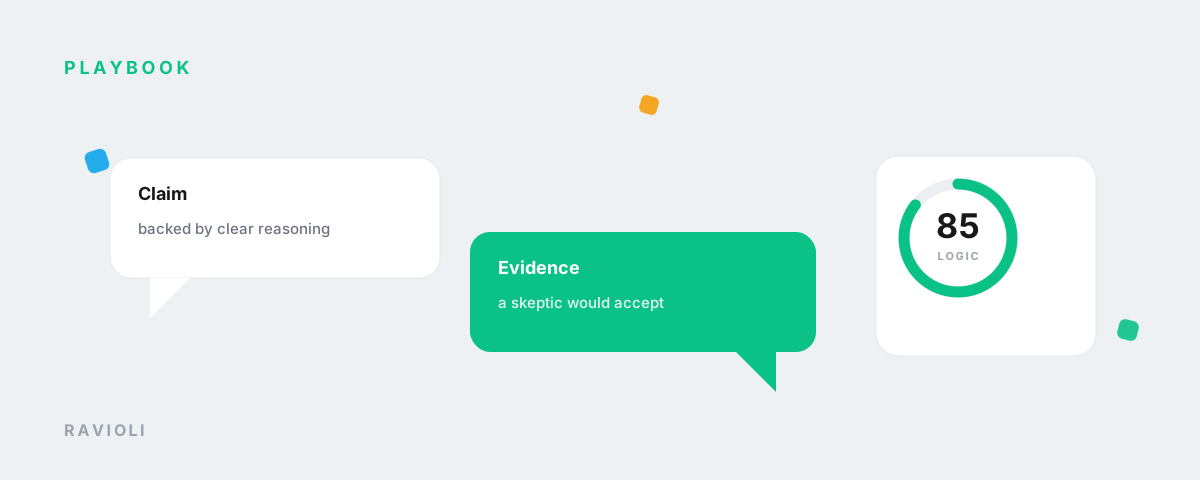
Most online arguments are won by whoever has more stamina, not better logic. That's a shame, because the skills that actually make an argument good are learnable. On a platform that scores reasoning instead of volume, they're the skills that pay off. Here's how to build an argument that holds up.
What actually wins a debate online?
Not volume. Not snark. Not getting the last word at 2 a.m.
What wins is a case a neutral reader finds hard to dismiss. Remember that in any public debate, your real audience usually isn't the person you're arguing with. It's everyone reading silently. You're rarely going to make your opponent concede. But you can absolutely make the onlookers think, "yeah, that side made more sense." That's the win condition, and it's won with clarity and evidence, not heat.
The structure of a strong argument
Almost every persuasive argument follows the same three-part shape. Miss a part and it wobbles.
1. Claim
Start with a specific, falsifiable claim. "This policy is bad" is a vibe. "This policy will raise costs for renters in the first year" is a claim, narrow enough that we can actually evaluate it. The more precise your claim, the stronger your footing.
2. Reasoning
This is the part people skip, and it's the most important. Reasoning is the bridge between your evidence and your claim. Don't just drop a statistic and assume it speaks for itself. Explain why it supports your point. A fact without reasoning is just trivia, and reasoning is what turns it into an argument.
3. Evidence
Back the claim with evidence a skeptic would accept: data, a concrete example, a credible source, a logical proof. The test isn't "does this support me," it's "would someone who disagrees with me still admit this is true?" Evidence that only persuades people who already agree with you isn't doing any work.
Put together, that's claim (what you believe), reasoning (why the evidence implies it), and evidence (the grounding). Keep it tight, in that order, and you've got something solid.
Anticipate the best objection
Here's the move that separates good arguers from great ones: argue against the strongest version of the other side, not the weakest. Find the best objection to your own claim and answer it before anyone raises it.
This does two things. It makes you look fair and confident, because you're clearly not afraid of the counterpoint. And it quietly steals your opponent's best ammunition before they can fire it. Beating a flimsy version of their argument (a "straw man") impresses no one. Beating their strongest version is what actually convinces the room.
Common fallacies to avoid
A few reasoning traps quietly sink more arguments than any opponent does:
- Attacking the person, not the point. Whether someone is annoying has no bearing on whether they're right.
- Straw-manning. Beating an argument nobody actually made wins you nothing.
- False choice. "Either we do X or disaster" usually ignores the dozen options in between.
- Correlation as causation. Two things moving together doesn't mean one caused the other.
- Moving the goalposts. If your claim gets answered, defend it. Don't quietly swap it for a new one.
Spotting these in your own writing is more valuable than spotting them in someone else's. Cut them before you post.
How Ravioli rewards logic, not noise
Ravioli is the free-to-play prediction market, and debates are one way to play it. Most platforms reward whoever is loudest or most popular. Ravioli is built to reward the opposite. In a Ravioli debate, your take is scored on its logic, on how well your reasoning connects to your claim and your evidence, not on how many people already agree with you.
That changes the game in a healthy way. A sharp argument on the unpopular side can still come out on top. And because scores stay hidden until the debate resolves, nobody can just pile onto whoever's currently winning. You're rewarded for the quality of your case, not for reading the room. For more on how that scoring works, see how debates score your reasoning.
Practice on a live debate
Reading about argument structure is like reading about swimming. You learn it by doing it: writing a real take, defending it, and seeing how it holds up.
Make a free account and jump into an open debate. Pick a side you actually believe, build your claim-reasoning-evidence case, and answer the best objection before someone makes it. Do that a few times and arguing well stops being a talent you either have or don't. It becomes a habit.
Start playing free on Ravioli
Trade prediction markets and put your read on the world to the test. No real money, no risk. Just predict, trade, and climb the leaderboard.