Prediction Markets vs. Sports Betting: What's the Difference?
By Vir Sanghavi, Founder, Ravioli · Updated May 22, 2026
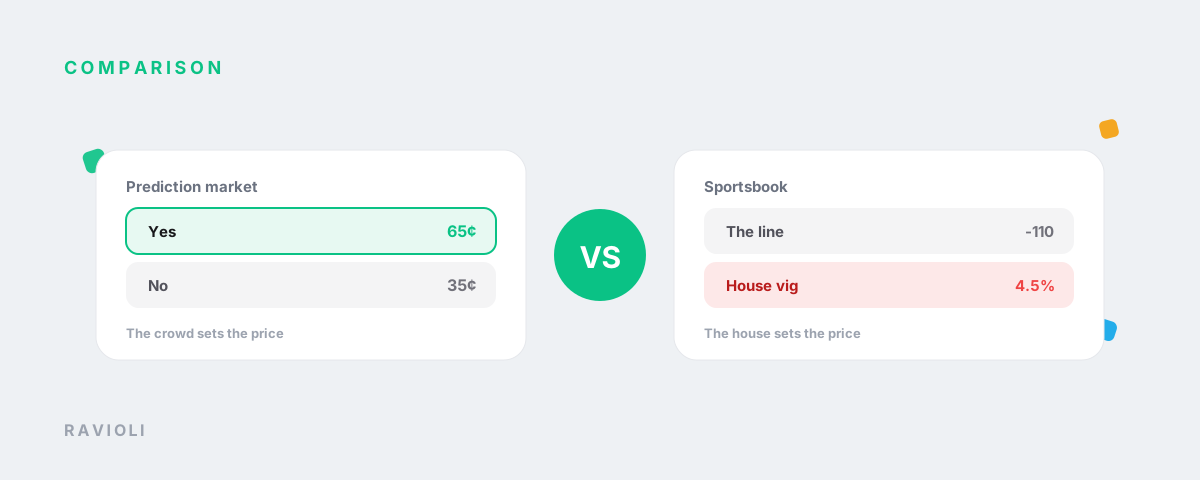
If you've ever placed a bet on a game, a prediction market will feel familiar: you pick a side, you put something on it, you find out if you were right. But under the hood, prediction markets and sportsbooks are built on opposite philosophies. Knowing the difference changes how you think about both.
The core difference
A sportsbook is a business. It sets the odds, takes your bet, and is on the other side of it. The book wants its lines to attract roughly equal money on both sides so it profits from the margin no matter who wins.
A prediction market has no house taking the other side. It's a marketplace where you trade with other people. The "odds" aren't handed down by a bookmaker; they emerge from everyone buying and selling, the same way a stock price emerges from a market. Nobody decrees that one team is 65%, because the crowd's trading settles there.
That single distinction, house-versus-you against you-versus-the-crowd, drives everything else.
Who sets the price?
At a sportsbook, the house sets the price and adjusts it to manage its own risk. The line you see is engineered to balance the book, not necessarily to reflect the truest probability.
In a prediction market, the crowd sets the price. Every trade is a small vote, weighted by conviction. If the listed chance looks too low, buyers pile in and drag it up; too high, and sellers push it down. The number you end up looking at is the market's collective best estimate, continuously corrected by anyone willing to bet against it. For a deeper look at how that price forms and what it means, see how market odds and resolution work.
Where does the edge go?
This is the part that matters most. A sportsbook builds in a margin, the vig, so that across all the action the house comes out ahead. You can be a sharp bettor and still be fighting that built-in headwind.
A peer-to-peer prediction market doesn't have a bookmaker skimming a guaranteed cut. You're matched against other traders, so the question isn't "can I beat the house's margin?" but "do I know something the crowd hasn't priced in yet?" The edge goes to whoever is best calibrated, not automatically to the platform.
Is it gambling?
Honestly, it depends on what you're playing. A real-money market on a coin-flip event isn't far from a bet. A real-money market where your research genuinely gives you an information edge looks a lot more like trading. The line is blurry, and the legal status of money-based prediction markets reflects that. It's an evolving, complicated area.
Ravioli sidesteps the whole debate by being free to play. There's no cash in, and nothing to withdraw. You trade with Sense, you climb the leaderboard, and you compete for prizes. That means you get the full experience of reading a market and being right, with zero money at risk, and without the legal gray zone.
What about skill?
Both activities reward knowledge, but prediction markets lean harder on it. Because the price reflects public information, your advantage comes from seeing something others have missed or weighting it correctly. That's a skill you can build.
And it's a skill that extends beyond yes-or-no prices. On Ravioli, debates take the same idea and apply it to arguments: instead of just picking a side, you make a case, and the quality of your reasoning is what earns the reward. It's the difference between guessing the outcome and defending why, a more demanding game and a more satisfying one.
Which one is right for you?
If you want the adrenaline of risking cash on a game, that's what a sportsbook is built for. Just go in clear-eyed about the house margin.
If you want to find out how good your read on the world actually is, and you'd rather not lose money discovering it, a free-to-play prediction market is the better classroom. The mechanics are real, the feedback is honest, and the only thing on the line is your reputation.
Start playing free and put your read to the test. You'll learn more about how markets work from ten trades than from ten articles.
Start playing free on Ravioli
Trade prediction markets and put your read on the world to the test. No real money, no risk. Just predict, trade, and climb the leaderboard.