Are Prediction Markets Accurate? What the Evidence Says
By Vir Sanghavi, Founder, Ravioli · Updated May 25, 2026
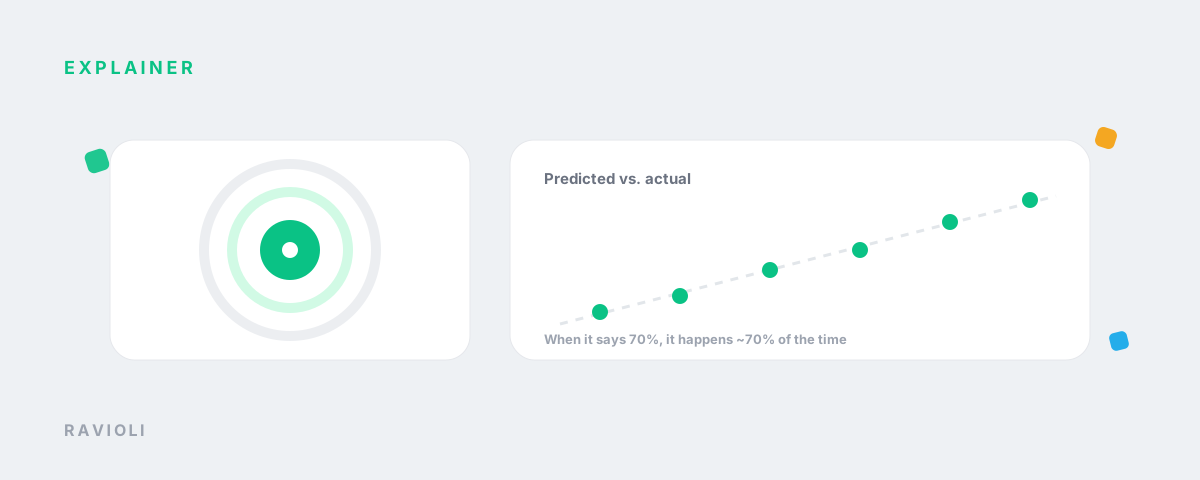
"Prediction markets are scary accurate" is a fun headline, but it's only half true. Markets are genuinely good forecasters, frequently beating polls and pundits, yet they're not crystal balls. Understanding when they're accurate and when they aren't makes you a far smarter reader of them.
How accurate are prediction markets, really?
The honest answer: usually quite good, and reliably better than most individual experts. The reason isn't magic, it's structure. A market price pools the knowledge of everyone trading and weights it by how much conviction each person is willing to back. That tends to produce a number that's well calibrated: when a market says 80%, those events really do happen about 80% of the time.
That's a higher bar than "did the favorite win?" A market that says a candidate has a 70% chance isn't wrong if the other candidate wins, because 30% things happen all the time. The test of accuracy is calibration across many predictions, and on that measure, liquid prediction markets hold up well. We dig into why a price equals a probability in how market odds and resolution work.
Why are they so accurate?
Two forces do the heavy lifting.
Skin in the game. When a wrong call costs you something, even just your standing, you only trade views you actually believe. That filters out cheap talk and leaves the price reflecting real conviction.
Information pooling. No single trader knows everything, but each knows something. One read the filings, one watched the locker-room news, one has a sharp gut. Trading mixes all of it into one number, and the independent errors tend to cancel out. The result is often sharper than any one expert, which is the "wisdom of crowds" in action.
When do prediction markets fail?
This is the part the hype skips. Markets get less reliable when:
- Volume is thin. A market with few traders is noisy, and a single big trade can shove the price around. Sparse markets are weak signals.
- The event is rare or unprecedented. With no base rate to anchor on, the crowd is guessing too, just collectively.
- Information is genuinely scarce. If almost nobody has an edge, the price reflects shared ignorance, not insight.
- Everyone is reading the same narrative. When the crowd piles into one story, independence breaks down and the price can drift with the hype instead of correcting it.
So a price isn't truth. It's the best available estimate given what's currently known, and it's only as good as the information and the trading behind it.
How to read a market price honestly
A few habits keep you grounded:
- Treat the price as a probability, not a prophecy. "70%" means it'll be wrong roughly three times in ten.
- Check the volume. A heavily-traded market is a stronger signal than a quiet one.
- Watch how the price moves on news. Fast, sensible reactions are a sign of a healthy market, while a price that ignores obvious news may be thin or stuck.
- Don't over-read tiny moves. A wiggle from 61 to 63 is noise more often than signal.
You can practice this read for free. Open a few live markets, note the prices, and check back after the news cycle. You'll quickly develop a feel for which markets are sharp and which are just thin.
The bottom line
Prediction markets are one of the best forecasting tools we have: usually more accurate than polls, faster than pundits, and honest about uncertainty in a way few experts are. But they're a mirror of the crowd, not an oracle. They're sharpest when many informed people are trading, and shakiest when they aren't.
Want to test how good your read is? Make a free account and start predicting, with no money and just your calibration on the line. And if you'd rather argue the case than just price it, our debates reward the quality of your reasoning, not luck.
Start playing free on Ravioli
Trade prediction markets and put your read on the world to the test. No real money, no risk. Just predict, trade, and climb the leaderboard.